Disclosure: ifaro is an independent style guide. Some links on this site are affiliate links — if you make a purchase through them, we may earn a small commission at no extra cost to you. This supports our work and keeps ifaro free. We only recommend pieces we believe honor your style identity. Affiliate Disclosure.
Pillar Guide
Carolyn Bessette-Kennedy's 90s Minimalism: How to Translate It to Your Kibbe Body Type
Dramatic — The Architect
Dramatic Classic — The Editor
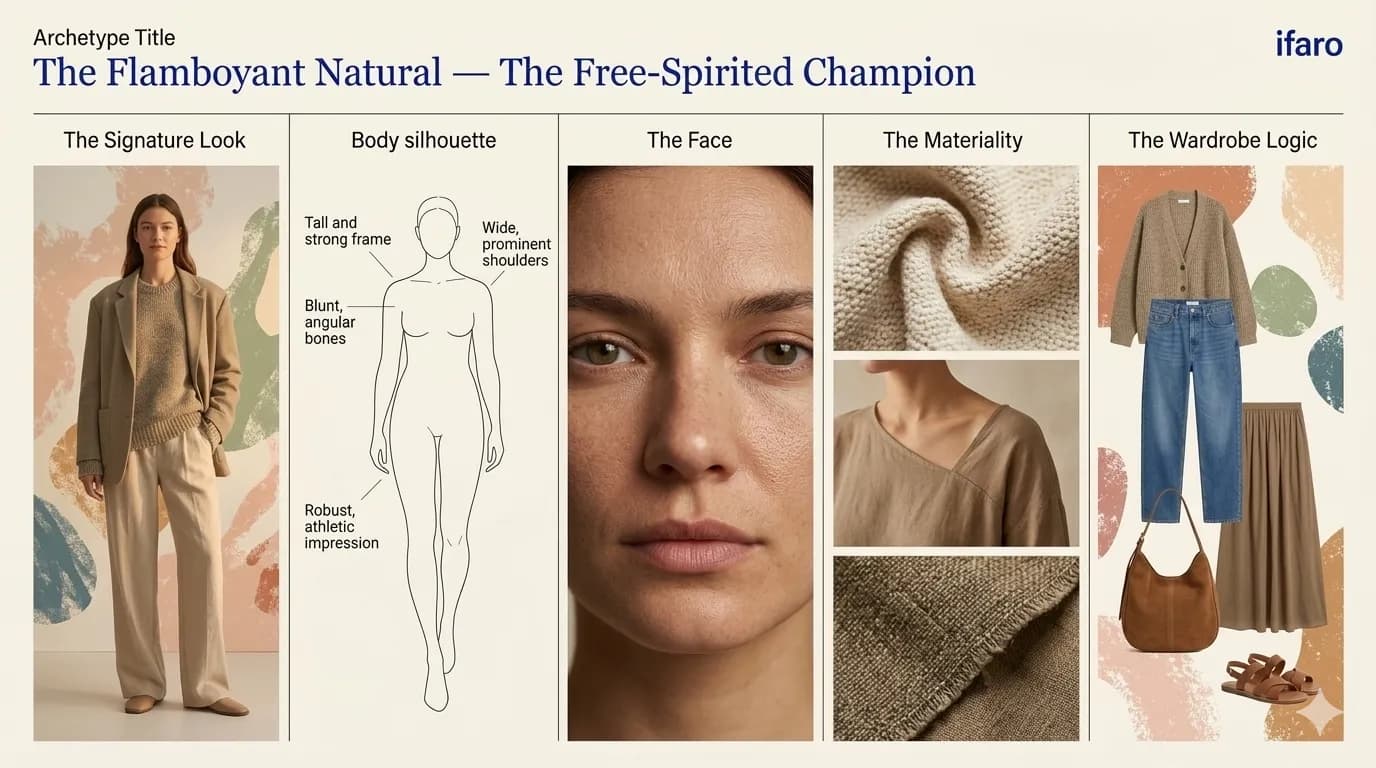
Flamboyant Natural — The Free-Spirited Champion
Soft Dramatic — The Diva Chic
Soft Natural — The Barefoot Poet
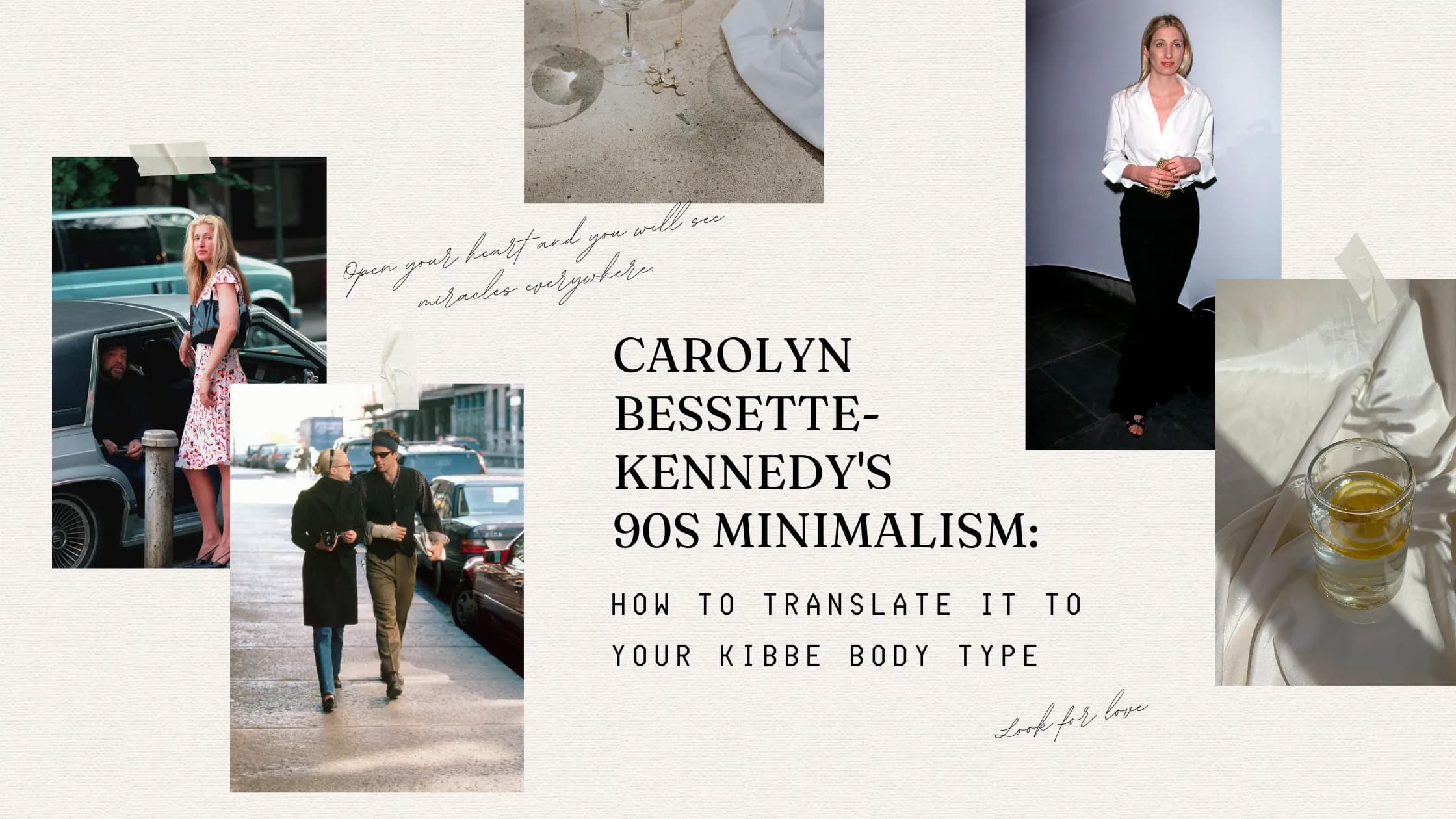
90s style — and Carolyn Bessette-Kennedy's wardrobe in particular — has taken off again. Her formula is easy to name: long unbroken vertical, sharp tailoring, monochrome, near-total absence of ornament. That is the native language of the Dramatic (D) archetype.
CBK was tall, narrow, long-limbed, with a strong jaw and angular features. Most of the Kibbe community reads her as Dramatic, and her clothes confirm it. She dressed to extend a vertical line and keep the eye moving without interruption.
The look adapts cleanly to Dramatic Classic (DC) and, in its slouchier register, to Flamboyant Natural (FN). It works against the petite, the curved, and the ornament-loving types: Romantic, Theatrical Romantic, and the Gamines.
YOUR EDIT
Pieces Curated for This Archetype
So how do you take her wardrobe apart and rebuild the useful pieces into your own type? Which signatures to keep, how to recut them for your lines, and the one she wore that you should leave alone. Here is the breakdown.
Five pieces, one system: turtleneck, cami, camel vest, black trouser, pointed flat. The CBK minimalism wardrobe in its irreducible form.
What 90s minimalism actually is, structurally
Strip the nostalgia and the aesthetic reduces to four mechanics:
Long vertical lines, uninterrupted by belts or breaks.
Sharp or clean edges rather than soft gathers.
A monochrome or tonal palette that removes horizontal cut-off points.
Almost no ornament — no ruffles, no print, no fuss at the neckline or cuff.
The Dramatic archetype — the vertical line, uninterrupted. Monochromatic column dressing where the silhouette is the whole statement.
Those four mechanics are also the textbook recommendations for Dramatic. So the question "who benefits from CBK minimalism" is mostly the question "whose lines want length, edge, and an absence of detail." Hold that test against each type and the answer falls out.
Dramatic: your factory setting
Carolyn Bessette-Kennedy — the Dramatic archetype in 90s minimalism: sharp vertical lines, monochromatic precision, zero excess.
If you read as Dramatic, CBK is the clearest reference you have.
Take the long column coat in camel or black, worn open over a matching base so the line runs floor to collar.
Take the sharp single-breasted blazer with a clean lapel and minimal hardware.
Take slim or straight trousers with a sharp crease, full-length, never cropped at a soft point.
Take the bias slip dress in a flat, fluid fabric — silk crepe, matte satin — cut as a column rather than a curve.
Keep jewellery sculptural and singular: one strong cuff, one clean earring, nothing that clusters.
The pieces to skip are the ones that break your vertical or soften your edge. Cropped jackets, gathered waists, busy small prints, delicate layered necklaces. None of these failed CBK because she rarely went near them.
Dramatic Classic: the same line, more finish
DC wants the Dramatic length with more symmetry and polish. CBK's tailored side translates almost directly; her looser, undone pieces need more structure.
Reach for her sharp suiting and her clean shift dresses. A tailored trouser suit in charcoal or navy, cut close but not severe, is the DC sweet spot. The white poplin shirt with a crisp collar reads beautifully here. Where CBK let a coat hang loose and undone, you want it cut to the body with a defined shoulder. Choose the structured camel coat over the slouchy one. Refined, matched, finished at every edge — that is the adjustment.
Where it goes wrong for DC: anything too raw or unconstructed. The deliberately rumpled, oversized end of 90s minimalism reads sloppy on a Classic frame rather than easy.
Flamboyant Natural: take the slouch, leave the sharpness
Easy pieces, honest fabrics — a Natural wardrobe that wears itself without trying.
This is the surprising winner, because CBK had a second mode beyond the tailoring — the oversized, slightly undone, thrown-on register. The man's-coat-over-everything. The loose trousers. The roomy knit. That mode is FN territory.
Reach for the long, relaxed coat with soft shoulders. The wide or straight trouser in a substantial fabric. The big tonal knit. Unstructured tailoring with give in it. The key edit: where the Dramatic version is razor-sharp, your version should be relaxed and textured. Swap crisp silk for raw silk, sleek wool for a chunkier weave, a knife-edge crease for an easy break. Keep the monochrome and the length. Lose the severity.
What undercuts FN here: anything stiff, fitted, or precious. A nipped waist or a fussy delicate detail will fight your broad, easy frame.
Soft Dramatic and Soft Natural: borrow the line, add the give
Both can use the vertical and the monochrome, with one non-negotiable change — fabric that drapes and a silhouette that allows some flesh.
Soft Dramatic gets the floor-length column and the dramatic coat, but in something lush and fluid that moves: heavy silk, velvet, a draped jersey gown rather than an austere matte sheath. The CBK slip dress works if it is bias-cut and sumptuous rather than flat and architectural. Pure unembellished minimalism can read severe on SD, so let the fabric carry the richness the ornament normally would.
Soft Natural takes the ease and the long line but softens every fabric and edge. A long fluid coat in a soft wool, relaxed wide trousers in something with drape, a column dress in jersey. Keep it tonal, keep it long, keep it soft.
Who should not chase this look
CBK minimalism does real damage to a few types, and styling won't fully fix it. The fastest way to see why is to look at who the other 90s icons were — women the decade loved just as much, who never went near the flat column, because their frames asked for the opposite.
Salma Hayek — the Romantic archetype in 90s red carpet style: body-skimming silhouettes, ornate detail, lush curves honored at every turn.
Romantic and Theatrical Romantic frames are short-waisted, curved, and ornament-loving. A flat, edge-driven, waist-erasing column tends to bury the curve and read as austere, even matronly. The slip dress that made CBK look like a blade makes a Romantic look swamped, unless it is recut to honour the waist and the bust — at which point it is no longer her dress. Picture Salma Hayek's 90s breakout looks (commonly read as Romantic): fitted, lush, curve-led, often in colour and with a defined waist. Or Winona Ryder, the decade's definitive doe-eyed ingénue and a frequent Theatrical Romantic read: delicate, slightly fey, soft tailoring and small-scale detail, never severe. Neither built a look on an unbroken austere line, and it would have quietly worked against both.
Winona Ryder — the Theatrical Romantic archetype in 90s fashion: ornate, intimate, and delicately dramatic — sharp bone structure wrapped in lush romantic detail.
The Gamines — Flamboyant Gamine and Soft Gamine — are compact and need broken lines, contrast, and animation. An unbroken monochrome vertical does the opposite of what their frames want; it elongates and quiets a body whose whole logic is spirited and segmented. Drew Barrymore's 90s wardrobe (often read Soft Gamine) was the proof point in reverse: broken-up, playful, mixed textures and prints, cropped and contrasted rather than long and tonal. Halle Berry (frequently read Flamboyant Gamine) built her look around a sharp pixie and crisp, compact, high-contrast pieces — not a single sweeping line. Borrow CBK's crisp white shirt or one sharp piece. Skip the head-to-toe column.
Drew Barrymore — the Soft Gamine archetype in 90s style: compact and playful, mixing edgy contrast with youthful softness.
If you fall into these types and love the aesthetic, the workable move is the accessory or the single piece, not the silhouette. One sharp blazer over your own native shapes. A monochrome palette on a cut that still defines your waist. The mood without the architecture.
Halle Berry — the Flamboyant Gamine archetype in 90s style: high contrast, bold proportion, angular energy in a compact and dynamic frame.
The one test that settles it
Before you copy any CBK look, ask whether it lengthens an unbroken vertical and removes detail. If your frame wants that — Dramatic, and to a point DC and FN — the look will do for you what it did for her. If your frame wants a defined waist, soft curves, or animated contrast, the same look will work against you, and the more faithfully you copy it the worse it gets.
90s minimalism is not universally flattering. It is precisely flattering, to a specific set of lines. Knowing whether those are yours is the whole game.
Not sure whether the column line is built for your frame? Discover your archetype and get the pieces mapped to your actual lines.