Complete Guide to Kibbe Body Types (2026 Updated)


You've followed the rules. Dressed for your "body shape." Tried the hourglass formulas, the pear-shape guidelines, the tall girl tricks. And somehow, standing in a full wardrobe, you've still felt like something was off.
That's because body-shape dressing addresses the wrong question. It asks: how do I minimize or disguise? The Kibbe system asks something completely different: what is the innate vocabulary your body actually speaks — and how do you build a wardrobe that fluently speaks it back?
Developed by stylist David Kibbe in the 1980s, the system has one elegant premise. Your bone structure, body flesh, and facial features together create a specific visual impression — an image identity. That identity has a grammar: certain silhouettes, fabrics, and proportions that work with your natural lines instead of fighting them. When your clothes match your identity, the garment disappears. What remains is simply, unmistakably, you.
Pieces Curated for This Archetype
There are thirteen identities across five families. This is your complete guide to all of them.
Not sure which one you are? → Discover your archetype in 10 minutes
The One Concept You Need First
Every Kibbe identity sits somewhere on a spectrum between two forces.
Yang is sharpness: elongated lines, angular bones, geometric structure, the authority of a strong shoulder. Yin is softness: curves, roundness, the sensuality of draped fabric. Most people aren't purely one or the other — you might have sharp yang bone structure with soft yin body flesh, or hold them in near-perfect balance.
Your identity describes exactly where you sit in that conversation. And once you know it, you'll start seeing patterns in every piece you've ever loved.

The Five Families
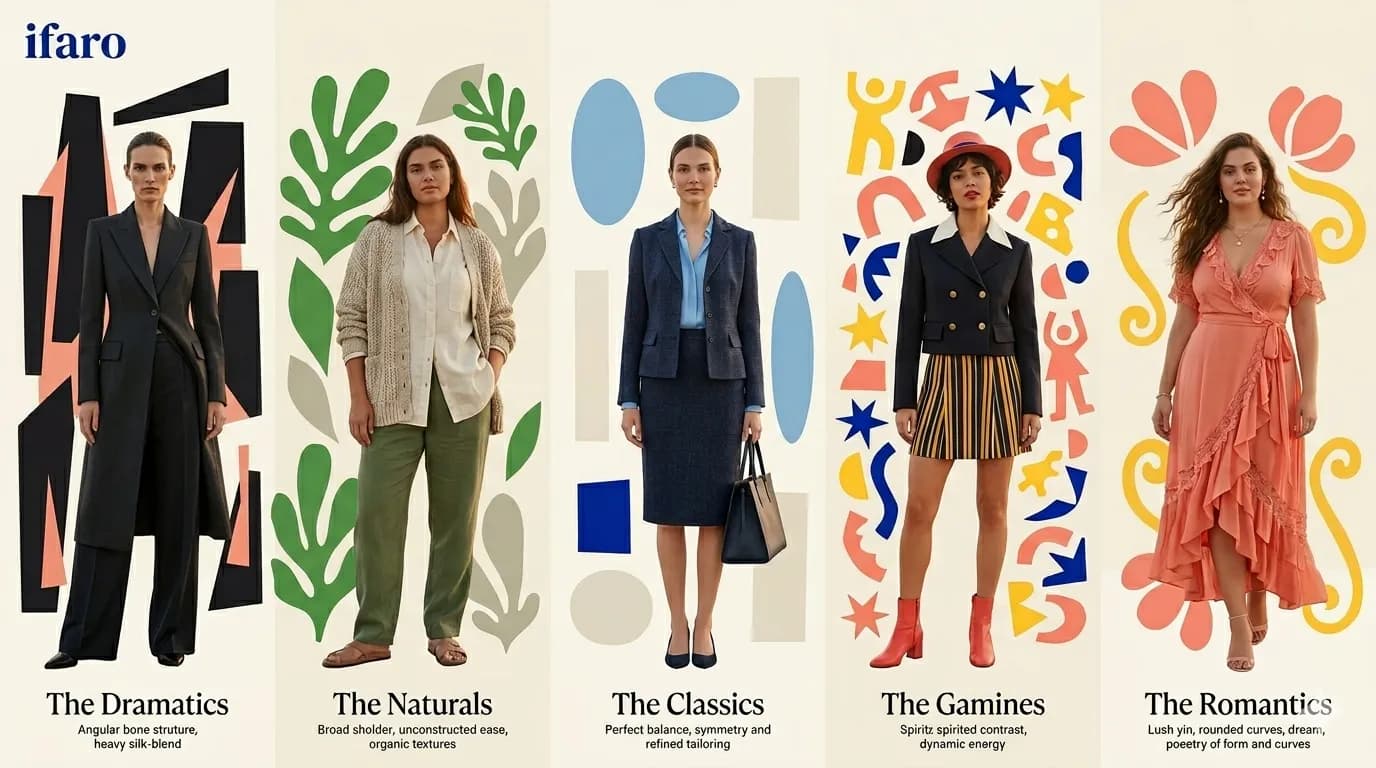
Think of these as neighborhoods. Thirteen identities, five clusters. Here's what each family is actually about — and who tends to land there.
The Dramatics — Long, narrow, sharp. If people regularly assume you're taller than you are, or if fitted clothes always seem to interrupt your line, you might be here. Kibbe types: Dramatic, Soft Dramatic.
The Naturals — Broad, relaxed, earthy. You have presence without trying. Structured or heavily tailored clothes feel wrong — like they're imposing on you rather than supporting you. Kibbe types: Flamboyant Natural, Natural, Soft Natural.
The Classics — Symmetrical, moderate, balanced. Nothing extreme in any direction. You look best when every element is in quiet agreement — and terrible when anything's overdone. Kibbe types: Dramatic Classic, Classic, Soft Classic.
The Gamines — Compact, contrasting, high-energy. You're petite, but "petite style" advice has never quite worked for you. The contrast between sharp and soft in your frame is the whole point. Kibbe types: Flamboyant Gamine, Gamine, Soft Gamine.
The Romantics — Curved, lush, defined waist. Flowing fabrics feel natural. Structured tailoring looks like it belongs on someone else's body. The more your clothes honor your curves, the better everything works. Kibbe types: Theatrical Romantic, Romantic.
Sound familiar? Your family might already be obvious. If not — the quiz will sort it.
The Thirteen Style Identities
The Dramatic — The Architect

All yang, all conviction. The Dramatic carries a long, narrow frame with prominent angular bone structure — sharp shoulders, a defined jawline, high cheekbones carved from intention. There is minimal natural waist emphasis. The limbs are long. The impression is statuesque.
Your sartorial language is geometry. Prioritize unbroken vertical lines in everything you wear: sheath dresses that fall like columns, straight-leg trousers with a precise break, long coats that move in a single clean plane. Fabrics should hold their shape — think gabardine, raw silk, firm leather, heavy linen. Detailing is spare but decisive: pointed lapels, sharp V-necklines, strong natural shoulders. One powerful note of contrast is all you need.
Tilda Swinton builds entire red-carpet narratives from this vocabulary — monochromatic, sculptural, never soft. Cate Blanchett commands the same territory with strong-shouldered blazers and gowns that refuse to break their vertical line.
The Soft Dramatic — The Diva Chic

The Soft Dramatic merges commanding yang structure with unmistakable yin lushness. The vertical line is long, the bone structure broad and prominent, but the bust and hips carry significant curve. A defined waist insists on being acknowledged.
This is draped drama. Your silhouettes should honor both forces simultaneously — T-shaped constructions work beautifully, with strong shoulders flowing into long lines that trace your curves without constricting them. Fabrics must be luxurious enough to drape and substantial enough to move: silk jersey, charmeuse, velvet, soft leather. Waist definition is non-negotiable. Detailing runs large and ornate — voluminous sleeves, soft pleating, gathers that cinch and release.
Sophia Loren understood this instinctively, favoring form-fitting gowns in rich fabrics that celebrated curve while maintaining a statuesque silhouette. Rachel Weisz continues the lineage with strong-shouldered pieces that drape and define in equal measure.
Explore the complete Soft Dramatic guide →

The Flamboyant Natural — The Free-Spirited Champion
Broad, open, and expansive. The Flamboyant Natural's frame is tall and strong, with blunt angular bones and wide, prominent shoulders. The overall impression is robust, athletic, and thoroughly unconstructable — your energy resists confinement.
Your wardrobe should breathe. Oversized sweaters, wide-leg trousers, long flowing skirts, relaxed jackets that don't try to nip or sculpt. Asymmetrical necklines and open collars accommodate your natural width beautifully. Fabrics should have texture and substance — chunky knits, raw cotton, suede, thick denim, tweed with visible weave. Detailing stays earthy and functional: patch pockets, rolled sleeves, unhemmed edges.
Cameron Diaz has made a quiet career of this aesthetic — relaxed-fit denim, open necklines, unconstructed outerwear that moves with her frame rather than constraining it. Jennifer Lawrence brings the same sensibility to the red carpet, choosing sweeping gowns with asymmetrical details that project ease without sacrificing presence.
Explore the complete Flamboyant Natural guide →

The Natural — The Wanderer
Pure yang ease. The Natural carries a moderate-to-broad frame with blunt, straight bone structure. Shoulders are somewhat wide, the body line is straight, and the overall impression is approachable, unpretentious, and unadorned. There is a grounded, straightforward quality to your lines that rejects fuss.
Your wardrobe lives in relaxed fits and natural fibers. Straight-cut trousers, simple knit sweaters, unlined blazers, shirt dresses that hang easily. Fabrics should feel organic — medium-weight cotton, linen, soft denim, wool blends with a comfortable hand. Silhouettes stay unconstructed but not oversized; the fit is easy, not sloppy. Earth tones and muted neutrals provide a natural foundation, and detailing remains minimal and functional.
Your power lies in the elegance of simplicity — garments that look effortless because they are.

The Soft Natural — The Barefoot Poet
Yang structure softened by yin curves. The Soft Natural carries a moderately broad frame — especially through the shoulders — but the body flesh is rounded, with noticeable curve through the bust, waist, and hips. The overall impression is fresh, open, and approachable.
Your wardrobe navigates two truths at once: breadth and softness. Relaxed silhouettes that still acknowledge your waist. Gathered fabrics that skim rather than cling. Wrap styles, A-line skirts, gently fitted tops in soft jersey, cashmere, challis, or lightweight linen. Open necklines — scoop, sweetheart, cowl — prevent constriction across your Natural shoulder line while honoring your softer contours. Detailing is organic and tactile: soft ruffles, gathers, asymmetrical hems.
Florence Pugh navigates this balance beautifully, choosing deep V-necks, gently puffed sleeves, and defined waists that present both her breadth and her curves with equal grace. Scarlett Johansson follows the same instinct — softly draped fabrics, open necklines, waist definition that never fights her frame.

The Dramatic Classic — The Editor
Balance with a sharper edge. The Dramatic Classic carries a symmetrical, moderate frame where the bone structure leans subtly angular — slightly tapered shoulders, a firm jawline, chiseled features. Body flesh is taut. The impression is poised, refined, and quietly authoritative.
Your wardrobe is a masterclass in tailored precision. Clean, crisp silhouettes that maintain neat, unbroken lines: sheath dresses, straight-leg trousers, pencil skirts, perfectly fitted blouses with sharp collars. Fabrics hold their shape without stiffness — tailored wool, gabardine, crisp cotton, shantung silk. Detailing is minimal and architectural: notched lapels, clean pleats, subtle geometric patterns like herringbone or pinstripes. Scale stays moderate. The overall effect is timeless with just enough edge to keep it modern.
Jackie Kennedy Onassis wrote the definitive text — tailored suits, A-line dresses, structured coats, always in clean necklines and perfect proportion. Olivia Wilde carries the tradition forward with impeccably tailored pantsuits and polished separates that radiate sophisticated authority.
Explore the complete Dramatic Classic guide →

The Classic — The Benchmark
Perfect equilibrium. The Classic is neither angular nor rounded, neither sharp nor soft. The frame is moderate in every dimension — moderate height, moderate bone structure, moderate body flesh. Facial features are symmetrical and balanced. This is the center of the Kibbe spectrum, and your power lies in that precision.
Your wardrobe honors proportion above all else. Tailored midi dresses with balanced necklines. Trousers with a clean, straight leg. Blazers that fit without excess structure or excess ease. Fabrics should be smooth and medium-weight — fine wool, quality cotton, silk blends — nothing too heavy, nothing too sheer. One considered accent against a neutral palette is more effective than a chorus of competing elements. Detailing is understated and symmetrical: a single well-placed dart, a balanced collar, classic pumps.
The danger for the Classic is extremes. Anything too oversized, too sharp, too ornate, or too relaxed disrupts the harmony your frame naturally projects. Your wardrobe works best when every element is in quiet, confident agreement.

The Soft Classic — The Grace
Balance, gently curved. The Soft Classic carries the same fundamental symmetry as the Classic, but the bone structure is slightly rounded and the body flesh carries a gentle softness. There is subtle waist definition. The impression is delicate, harmonious, and serenely elegant.
Your wardrobe flows. Soft fabrics in moderate silhouettes — silk, chiffon, cashmere, fine jersey, materials that drape beautifully without losing their shape. Empire waists, A-line skirts, blouses with gentle gathers, cardigans that skim the body. Necklines stay rounded — scoop, bateau, sweetheart. Detailing is soft and symmetrical: delicate pleats, subtle ruffles, rounded edges. The palette gravitates toward tonal harmony rather than stark contrast.
Grace Kelly defined this territory with flowing chiffon, elegant scarves, and ensembles that emphasized gentle curves within perfect symmetry. Naomi Watts carries the same sensibility in soft monochromatic pieces with gentle draping and subtle waist definition — never harsh, always considered.

The Flamboyant Gamine — The Spark
Contrast at full volume. The Flamboyant Gamine carries a petite, narrow frame with sharp, angular bone structure — defined shoulders, a pointed jawline — compressed into a compact, high-energy package. The limbs can be long relative to your height, but the overall impression is small, dynamic, and decidedly magnetic.
Your wardrobe thrives on deliberate juxtaposition. Short, crisp, broken lines in bold separates: cropped blazers, tapered trousers, fitted turtlenecks, structured mini-skirts. Fabrics should hold a shape — heavy cotton, poplin, gabardine, firm denim, leather. Contrasting colors, geometric patterns, chunky buttons, wide belts. The key is crisp detail at a compact scale. Nothing flowing. Nothing soft. Nothing that blurs the edges.
Audrey Hepburn built her entire visual identity from this vocabulary — cropped trousers, fitted bodices, sharp bobs, broken lines that flattered her petite frame and amplified her angularity. Liza Minnelli took the same energy to its theatrical extreme with sequined tailoring, strong shoulders, and bold graphic hair.

The Gamine — The Pixie
Pure contrast in miniature. The Gamine holds angular and rounded, sharp and soft in a compact frame that vibrates with infectious energy. Bone structure is a mix of slightly sharp and slightly delicate elements. The impression is small, spirited, and always a little unexpected.
Your wardrobe plays with opposites at a petite scale. Cropped jackets paired with fitted trousers. Graphic tees under structured blazers. Geometric accessories that punch above their weight. Fabrics are light to medium weight with some structure — textured cotton, light wool, compact weaves. Silhouettes stay compact and close to the body; nothing oversized, nothing flowing. The energy comes from contrast: mixing textures, playing with proportion, pairing crisp with soft in small, intentional doses.
The Gamine's signature move is making something unexpected look completely inevitable.

The Soft Gamine — The Ingenue
Contrast, softened. The Soft Gamine carries a petite frame with delicate, slightly sharp bones, but the body flesh tells a different story — pronounced curve through bust and hips, a defined waist. Facial features are round, soft, and youthful, often with large, expressive eyes. The impression is vivacious, charming, and thoroughly captivating.
Your wardrobe demands a playful balance of small rounded shapes and crisp details. Fitted silhouettes that emphasize the waist: peplum tops, tapered skirts that stop at the knee, cropped jackets. Fabrics should be soft enough to drape but structured enough to hold a shape — jersey, challis, lightweight wool, soft silk. Detailing runs small and ornate: ruffles, bows, scalloped edges, Peter Pan collars, puff sleeves. The hemline stays short to honor your petite scale.
Reese Witherspoon consistently demonstrates this balance — fitted dresses with defined waists, playful prints, shorter hemlines that complement her petite and curvy frame. Every piece is precisely scaled to her energy.

The Theatrical Romantic — The Siren
Opulent yin with an underlying spark of dramatic intensity. The Theatrical Romantic carries a petite frame with lush curves — full bust, deeply defined waist, rounded hips — combined with slightly sharp or narrow bone structure in the shoulders and jawline. Facial features are intricately defined. The impression is intensely glamorous and unapologetically sensual.
Your wardrobe is a celebration of curve and detail. Extremely fitted silhouettes with strong waist emphasis — the hourglass is your foundation. Body-skimming fabrics in rich, luxurious materials: silk, velvet, chiffon, lace, brocade. Detailing runs ornate and intricate: ruffles, delicate beading, embroidery, sequins. Necklines should be defined — sweetheart, portrait, deep V — and sleeves should taper. Every element works to honor the interplay between your dramatic bone structure and your lush, romantic flesh.
Salma Hayek embodies this identity with meticulous consistency — form-fitting gowns with intricate embellishment, cinched waists, and deep necklines that celebrate every curve without compromise.
The Romantic — The Muse

Pure, undiluted yin. The Romantic carries a petite hourglass frame with soft, rounded bones and lush body flesh. The waist is naturally defined. The limbs tend toward short. The facial features are soft, round, and delicate. The impression is luminous, dreamlike, and gently powerful.
Your wardrobe is a poetic expression of curve. Soft, flowing silhouettes with strong waist emphasis — empire waists, draped necklines, full skirts with gentle gathers and shirring. Fabrics should feel as soft as they look: chiffon, silk, cashmere, fine jersey, velvet. Heart-shaped and rounded necklines honor the curve of your upper body. Detailing is ornate, delicate, and rounded — ruffles, bows, lace, embroidery, small pleats. Nothing angular. Nothing sharp. Nothing that contradicts the fluid line your body naturally describes.
Marilyn Monroe understood this completely. Every garment she chose — form-fitting, draped, cinched at the waist, softened at the neckline — served a single purpose: to let her natural softness speak without interruption.
Three Things People Get Wrong About Kibbe
"It's about height." It isn't. The system reads the visual impression of length, not your actual measurements. A shorter woman can project strong vertical yang if her lines are long relative to her own frame. The mirror tells you more than the ruler.
"It tells me what I can't wear." It doesn't. Your identity provides a grammar, not a restriction. Once you know your Soft Dramatic lines thrive in draped fabrics with waist definition, the creative range within that grammar is enormous — color, texture, mood, era, all of it still available.
"I need to start over." You don't. Look at the pieces you already love — the ones that feel right when you wear them — and notice the patterns. Your identity is already woven through your instinctive choices. This framework gives you the vocabulary to understand why.
Your Next Step
If one or two of these descriptions felt like you — that's the answer.
If you're still uncertain, the quiz takes about ten minutes and reads the interplay of yin and yang in your specific frame. At the end: your identity, your style grammar, and the first pieces worth looking at.
And if you want to go deep on any single type — each one has a dedicated guide with outfit formulas, the brands that consistently get it right, and the specific pieces worth adding to your wardrobe now.
Boa sorte.