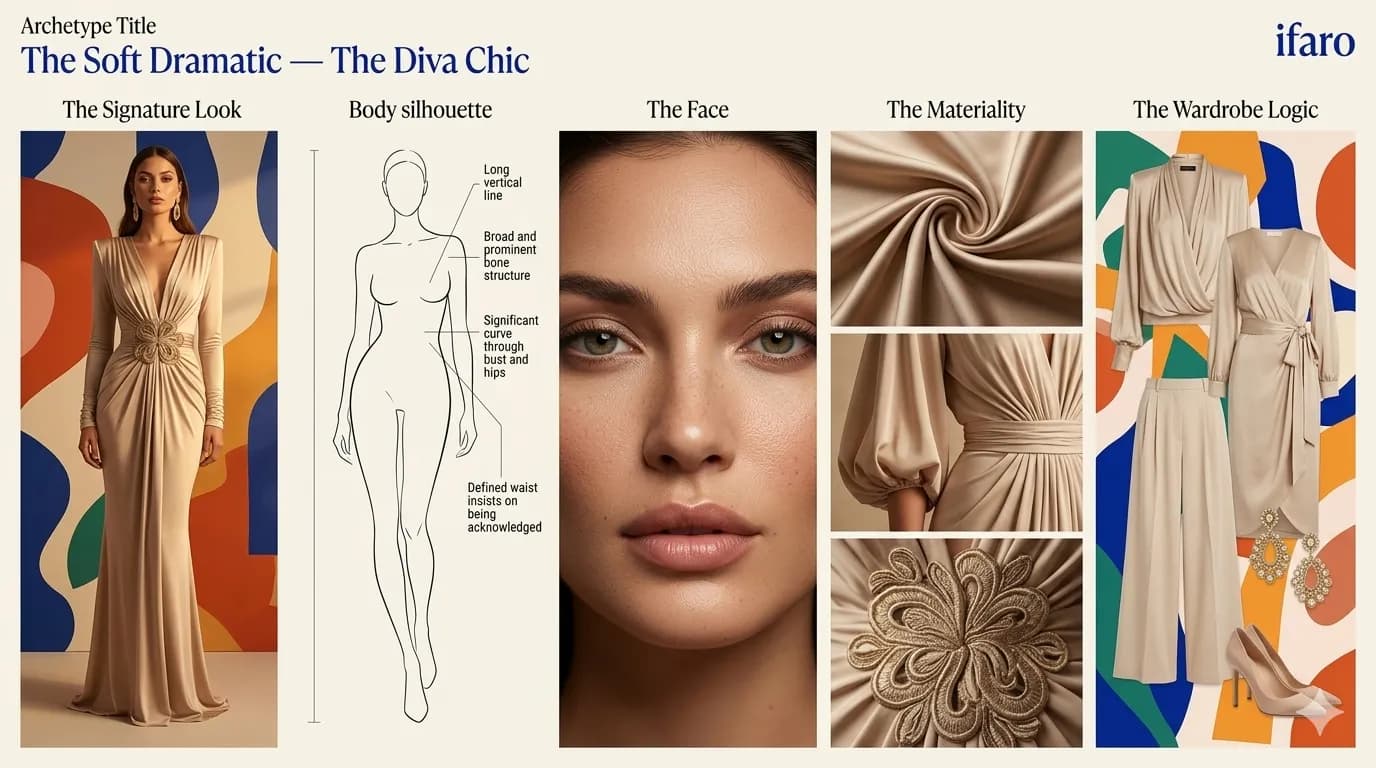
The Soft Dramatic occupies a singular position in the Kibbe spectrum: dominant yang bone structure carrying significant yin flesh. Understanding this duality is the foundation of every styling decision you will make.
Your yang framework announces itself through length. The vertical line is long and prominent — you project height and presence regardless of your actual measurements. Bone structure is broad and angular, particularly through the shoulders, hands, and feet. The jawline may carry definition. The overall skeletal impression is bold, wide, and statuesque.
Your yin overlay tells a different story. The bust is full, the hips rounded, the waist naturally defined. Body flesh is soft, even lush. Facial features may be large, full-lipped, or sensually rounded. There is a warmth and richness layered over the angular frame beneath.
This is not a contradiction — it is your signature. The Soft Dramatic's power lies precisely in this interplay. When your silhouettes accommodate your length and your curve, when your fabrics drape over structure without flattening it, the effect is magnetic. You look like yourself.
The Soft Dramatic Silhouette
Your silhouette strategy serves one purpose: to maintain your commanding vertical line while honoring the curves that live within it. Every successful Soft Dramatic outfit resolves this equation.
The T-shape is your foundational silhouette. Strong, slightly broadened shoulders tapering into a long, flowing line that traces — but never constricts — the body beneath. Think of a wide-shouldered blazer over a bias-cut skirt that falls to the ankle. The top creates breadth and authority; the bottom creates movement and sensuality. The waist, cinched or belted, bridges the two.
The column with interruption is your second essential shape. A long, unbroken vertical — a floor-length dress, a head-to-toe tonal ensemble — with one strategic point of definition at the waist. A belt, a seam, a gather. The vertical stays intact, but the curve announces itself.
The draped wrap is your third. Wrap dresses, wrap coats, wrap blouses — any construction that crosses the body diagonally, creating simultaneous length and waist definition through a single gesture. The diagonal line elongates while the wrap construction naturally accommodates bust and hip volume.
Silhouettes that flatten you into a straight line ignore your yin. Silhouettes that break your vertical into short, fussy segments ignore your yang. The Soft Dramatic silhouette always does both things at once — it is long and curved, structured and fluid.
Fabric Intelligence

Fabric is where the Soft Dramatic equation either sings or collapses. The wrong fabric will betray you faster than the wrong cut. Too stiff and you lose your sensuality. Too flimsy and you lose your presence.
Your primary fabrics occupy a specific territory: substantial enough to carry drama, fluid enough to honor curve. Silk jersey moves with the body while holding enough weight to drape cleanly. Charmeuse catches light and falls in liquid folds over the hip. Velvet carries richness and body without rigidity. Cashmere drapes softly but holds a silhouette. Matte jersey, ponte, and crepe offer structure with stretch — essential for pieces that need to define the waist and skim the hip simultaneously.
Your secondary fabrics extend the palette for specific garments. Soft leather for jackets and skirts — structured but supple. Brocade and jacquard for evening — textural drama with inherent weight. Lightweight wool crepe for tailoring — it holds a shoulder and releases at the hip. Silk chiffon as a layering fabric — never as a primary structure, but as a veil over something more substantial.
Fabrics to approach with caution. Stiff cotton holds a shape your body doesn't need imposed on it. Heavy canvas or denim without stretch fights your curves. Anything papery, thin, or unlined will cling where it should drape and flatten where it should flow. Crisp poplin works only in oversized, unconstructed silhouettes — and even then, it rarely serves you as well as a softer alternative.
The litmus test is simple: does the fabric move when you move? Does it have enough body to create a clean line, but enough give to follow your contours? If yes, it belongs in your wardrobe.
Necklines and the Upper Body
The Soft Dramatic's upper body presents a specific styling challenge: broad shoulders, often a full bust, and a long neck that contributes to your vertical impression. Your neckline choices either amplify this architecture or fight it.

Deep V-necklines are your most reliable ally. The V elongates the torso, draws the eye downward along the vertical, and creates space for a full bust without constriction. The deeper the V, the more drama — and drama is your native tongue.
Sweetheart and portrait necklines honor your yin. They frame the décolletage with a soft curve that echoes the roundness of your body flesh, while still opening the chest and maintaining vertical emphasis.
Off-shoulder and one-shoulder constructions celebrate your broad, angular shoulder line — one of your most distinctive features. These necklines showcase the yang framework while the exposed skin adds sensuality. They work especially well in soft, draped fabrics that fall from the shoulder rather than sitting rigidly on it.
Cowl necklines drape beautifully on the Soft Dramatic. The gathered fabric adds textural interest at the bust, the soft folds read as yin detailing, and the overall effect is both relaxed and luxurious.
High, closed necklines require care. A mock neck in a clingy fabric can work — it maintains the vertical and lets the body's curves do the talking. A structured collar or a buttoned-up shirt, however, tends to create tension across the bust and shoulders, working against both your breadth and your softness.
Waist Strategy
The waist is your pivot point — the hinge where yang structure meets yin curve. Ignoring it is one of the most common mistakes Soft Dramatics make, and the correction is immediate.
Defined, never constricted. Your waist should be acknowledged, not strangled. A belt in a complementary fabric, a seam that nips inward, a wrap that crosses at the natural waistline — these all work. A wide, rigid corset belt or a sharply cinched waistband can look uncomfortable and compete with your natural proportions.
Placement matters. Your natural waist — the narrowest point of your torso — is almost always the right place to define. Empire waists cut your vertical line too high. Dropped waists ignore your curve entirely. The natural waist lets the upper body maintain its broad, angular authority while the lower body flows.
Monochromatic definition is a sophisticated approach. When you dress in a single color from shoulder to hem, the waist can be defined by construction alone — a seam, a gather, a subtle change in fabric weight — without introducing contrast that breaks the vertical. This is the Soft Dramatic at her most refined: one long, unbroken color story with curve visible only through shape.
Proportions and Scale
The Soft Dramatic operates at a larger scale than most identities. Your details, your accessories, your patterns — all should match the boldness of your frame and the richness of your curves.
Oversized over undersized, always. A large, sculptural earring reads proportionate on you; a small, delicate stud disappears. A wide, flowing scarf complements your shoulders; a narrow silk ribbon looks lost. Scale your accessories to your frame, and they will feel intentional rather than overwhelming.
Long over short. Your hemlines, your necklaces, your coat lengths — all benefit from length. A midi or maxi skirt maintains your vertical. A cropped jacket, unless paired with a high-waisted bottom that reclaims the long line, breaks you into segments. When in doubt, choose the longer option.
Simple over complex. This seems counterintuitive for an identity associated with drama, but the Soft Dramatic's drama comes from scale and gesture, not from fussy detail. One bold neckline. One statement sleeve. One rich fabric. You do not need all three in the same garment. The most powerful Soft Dramatic pieces are often the simplest in construction — their impact comes from the fabric, the cut, and the body wearing them.
Color and Pattern
Color is a Soft Dramatic's amplifier. Used well, it deepens your presence. Used carelessly, it fragments it.
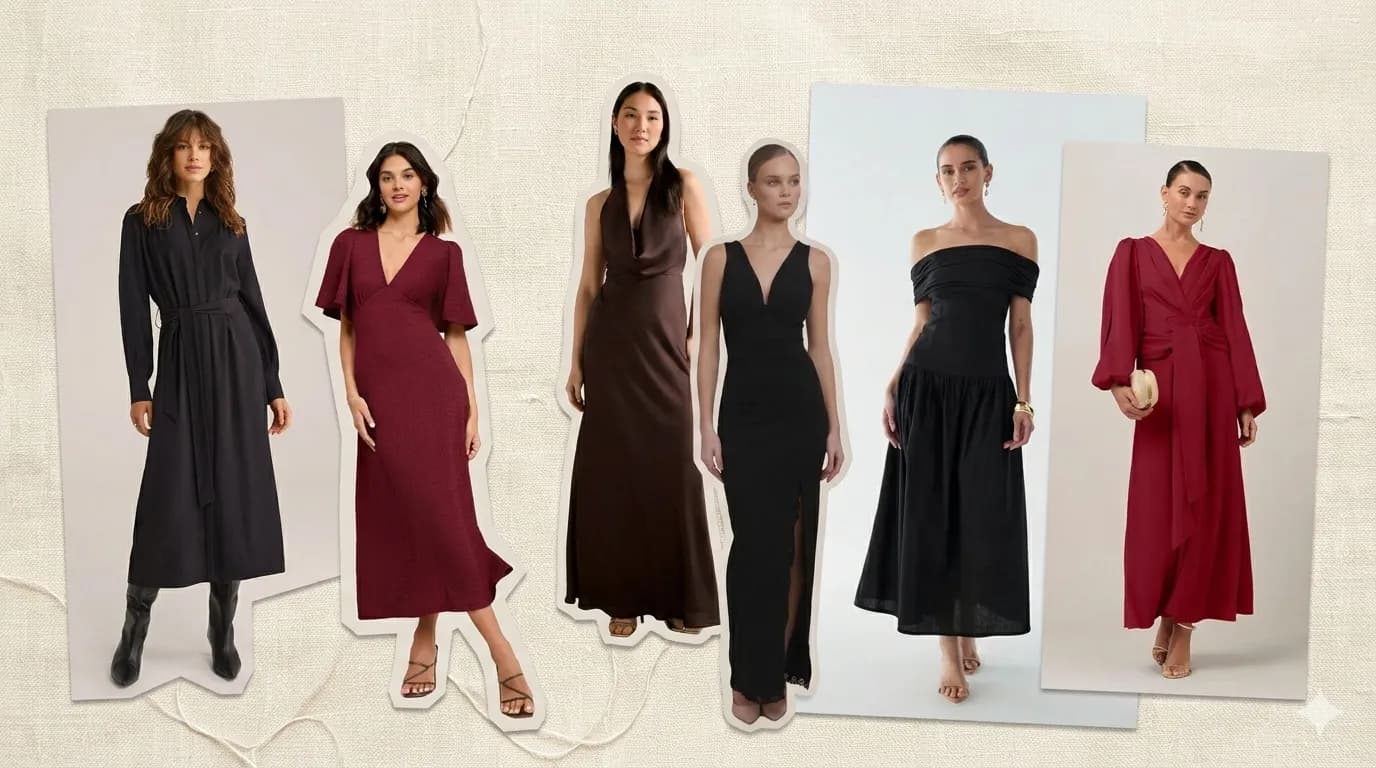
Tonal dressing is your superpower. Head-to-toe in a single color family — deep burgundy, midnight navy, rich chocolate, true black — creates an unbroken vertical that makes your frame look even more commanding. The eye travels the full length without interruption, and the curves read as sculpture within a single plane.
Rich, saturated tones serve you better than pastels or muted neutrals. Deep jewel tones — emerald, sapphire, ruby, amethyst — carry the same weight and intensity as your physical presence. They feel proportionate. Pale, washed-out colors can make a bold frame look underdressed.
High contrast works when it is bold, not busy. A black top with a white bottom reads as two decisive blocks — dramatic and clean. A small floral print or a busy geometric scattered across the body, however, breaks your vertical into fragments and undermines your scale. If you wear pattern, choose large-scale motifs: abstract sweeps, bold color blocking, oversized florals that match the bigness of your frame.
Monochromatic with one accent is a failsafe formula. An all-black ensemble with a single scarlet lip. A navy column dress with gold statement earrings. The simplicity of the base honors your vertical; the accent provides the drama.
Outfit Formulas
These are not prescriptions. They are starting points — tested combinations of silhouette, fabric, and proportion that reliably resolve the Soft Dramatic equation. Adapt them to your color palette, your lifestyle, your mood.

Formula One: The Power Drape. A wide-shouldered blazer in soft wool crepe, worn open over a silk camisole, tucked into high-waisted wide-leg trousers in the same tone. The blazer provides yang structure and breadth. The camisole provides yin softness at the neckline. The trousers maintain the vertical. The waist is defined by the tuck. One pair of sculptural gold earrings.
Formula Two: The Evening Column. A floor-length dress in matte jersey or silk, with a deep V-neckline and long sleeves. The fabric skims the bust and hip, defining the waist through construction rather than a belt. A single color from neckline to hem. Hair swept to one side. One bold cuff.
Formula Three: The Weekend Luxe. Wide-leg jeans in a dark wash, a cashmere V-neck sweater in a rich tone, and a long wool coat with soft shoulders. The jeans maintain the long line. The cashmere drapes at the bust. The coat adds presence without rigidity. Low-heeled boots with a pointed toe.
Formula Four: The Draped Statement. A wrap dress in silk jersey — knee-length or longer — with a deep crossover neckline and long, slightly flared sleeves. The wrap construction defines the waist, accommodates the bust, and creates diagonal movement. One pendant necklace that falls into the V. Strappy heels.
Formula Five: The Layered Tonal. A fitted turtleneck in merino wool, a long, unstructured cardigan in the same color family, and a bias-cut midi skirt in silk or satin. The turtleneck defines the torso. The cardigan adds a second vertical layer without structure. The skirt flows. Everything stays within two shades of the same hue.
Seasonal Adaptation
Your Soft Dramatic principles do not change with the calendar. Only the fabrics and layers shift.
In warmer months, your best friend is the bias-cut midi in silk or viscose — it provides movement and curve accommodation with minimal fabric weight. Linen works only when it is relaxed and slightly oversized, never stiff or boxy. Cotton-silk blends in camisole or wrap constructions keep you cool while maintaining drape. Open-toe heeled sandals with a single strap extend the leg line.
In colder months, the Soft Dramatic flourishes. Heavy cashmere, soft wool, velvet, and leather — your fabrics naturally gravitate toward autumn and winter weight. Long coats with soft shoulders become your signature outerwear. Layering works when each layer is long and fluid: a silk blouse under a long cardigan under a knee-length coat, all in the same tonal family. Tall boots maintain the unbroken vertical beneath long skirts and wide-leg trousers.
In transitional seasons, trench coats with a belted waist serve beautifully — provided the trench is long enough (mid-calf or below) and the fabric has enough drape. Light wool blazers with soft shoulders carry you through spring evenings. Silk scarves draped loosely around the neck add warmth without bulk.
Common Missteps
Understanding what disrupts your lines is as valuable as understanding what honors them.
Boxy, unconstructed shapes ignore your waist entirely. Oversized sweatshirts, shapeless shift dresses, straight-cut tunics — these silhouettes treat your body as a rectangle when it is anything but. They hide your curve without gaining anything in return.
Short, cropped proportions break your vertical. A cropped jacket that ends at the rib cage, a mini skirt, a short-sleeved shirt that hits at the widest point of the upper arm — all of these segment your long line into pieces, and the Soft Dramatic's power depends on that line remaining as continuous as possible.
Stiff, rigid fabrics fight your curves. Heavily starched cotton, thick canvas, stiff taffeta — these materials hold a shape of their own rather than negotiating with yours. The result is a garment that looks like it is wearing you, not the other way around.
Small-scale details disappear on you. Tiny floral prints, thin chain necklaces, delicate studs, narrow belts — they read as afterthoughts against your bold frame. They create a mismatch of scale that makes your body look larger rather than adorned.
Overly casual, shapeless layers work for other identities but undercut yours. The effortlessly rumpled look that flatters a Flamboyant Natural — oversized linen, rolled sleeves, open collars — reads as unfinished on the Soft Dramatic. Your frame wants intention. Your curves want acknowledgment. Even your most casual pieces should carry some element of shape and drape.
Building Your Personal Edit
Start where you are. Open your wardrobe and look for the pieces that already make you feel commanding and fluid simultaneously — the dress that makes your waist appear without trying, the blazer that sits perfectly on your shoulders, the trousers that fall in a clean line to your ankle. These are the garments that already speak your Soft Dramatic language. Notice their common threads: the fabric weight, the silhouette, the way they handle your waist.
From there, build deliberately. A capsule wardrobe for the Soft Dramatic does not need to be large — it needs to be cohesive. A few investment-grade pieces in fabrics that drape correctly will serve you far better than a closet full of trend-driven purchases that ignore your lines.
Your essential foundation: one impeccable blazer with soft shoulders. One wrap dress in silk or jersey. One pair of wide-leg trousers in a dark, fluid fabric. One long coat that falls below the knee. One pair of heeled boots that extend the leg. From this base, you can build an entire wardrobe — adding color, texture, and statement pieces — without ever losing the thread of who you are.
The Soft Dramatic in Context
The Soft Dramatic shares borders with two neighboring identities, and understanding the distinctions sharpens your own styling instincts.
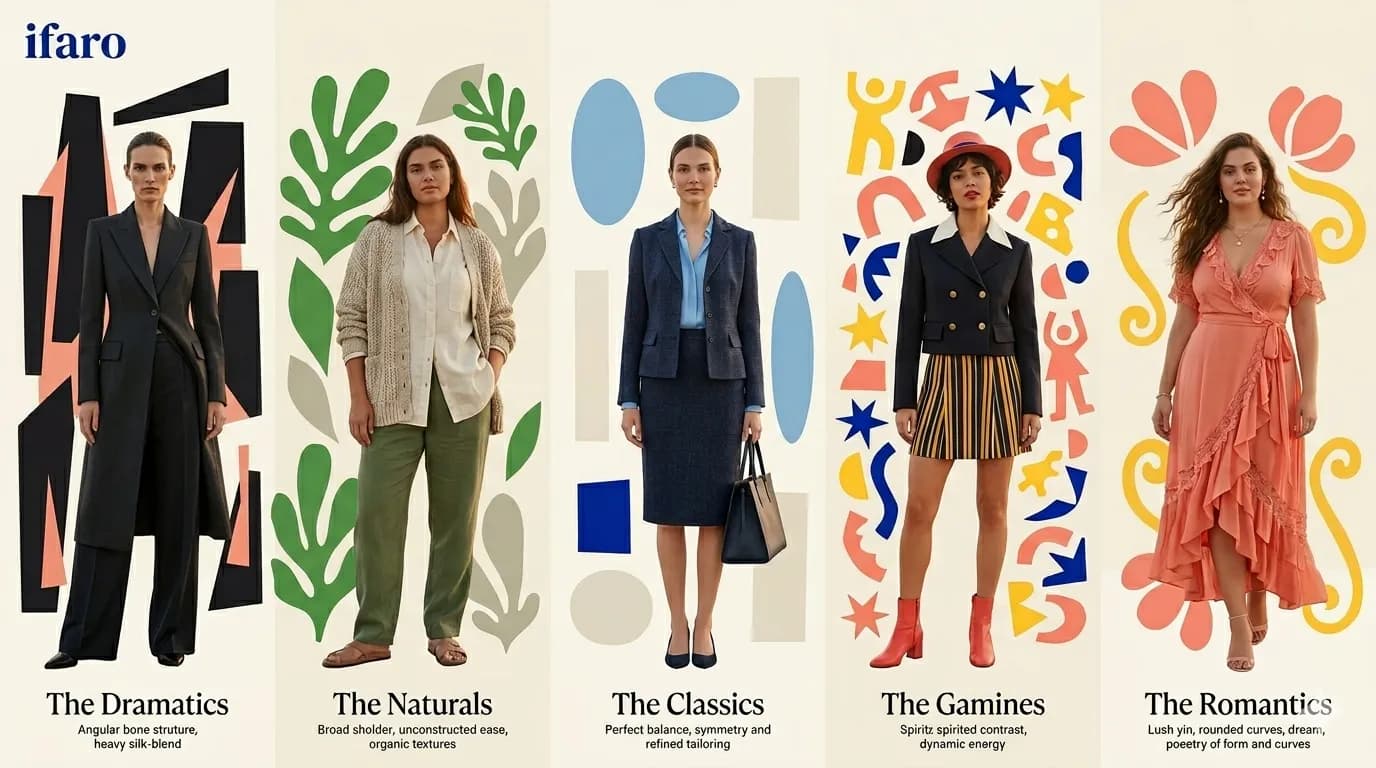
Soft Dramatic vs. Dramatic. The pure Dramatic carries the same commanding vertical and angular bone structure, but without the yin softness in body flesh. The Dramatic's wardrobe is sharper, more geometric, less concerned with curve accommodation. If you find that strictly angular, minimalist garments make you look austere rather than powerful — if something feels missing when your curves are not acknowledged — you are likely Soft Dramatic rather than Dramatic.
Soft Dramatic vs. Soft Natural. The Soft Natural also blends yang structure with yin softness, but from a different starting point. The Soft Natural's yang is width — broad, blunt, horizontal. The Soft Dramatic's yang is length — tall, narrow, vertical. The Soft Natural thrives in relaxed, unconstructed shapes. The Soft Dramatic needs more drama, more intention, more definition at the waist. If oversized, casual silhouettes make you feel underdressed rather than at ease, the Soft Dramatic is your home.
Explore how Soft Dramatic compares to Flamboyant Natural →
Your Next Step
You now hold a detailed map of the Soft Dramatic's sartorial language — from the T-shape silhouette to the bias-cut midi, from the deep V-neckline to the tonal column. The framework is here. The application is yours.
If you have not yet confirmed your style identity, our journey of self-discovery will guide you through a series of thoughtful prompts that read the specific balance of yin and yang in your frame. And if the Soft Dramatic resonates — if you recognize yourself in these pages — trust that recognition. Your body has been speaking this language all along.
Discover Your Archetype →
Return to the Complete Guide to Kibbe Body Types →
Boa sorte.